Managing a Nearshore Web Development Partnership Effectively
Learn how a nearshore web development partnership improves agency workflows through time-zone alignment, real-time communication, and shared standards.

Many US-based digital agencies and small businesses reach a point where they need to scale their technical capacity without the overhead of local full-time hires. While offshore outsourcing to regions with a 12-hour time difference seems cost-effective on paper, the reality often involves frustrated project managers waiting 24 hours for a simple CSS fix or a database correction. This communication latency can derail tight launch schedules and harm client relationships.
A nearshore web development partnership solves this by aligning development talent with US business hours. Working with a developer in Latin America means your team is online at the same time, allowing for real-time problem solving and instant feedback. In this guide, we will look at how to structure this partnership to ensure high-quality output, seamless communication, and long-term reliability for your 2026 projects.
The Strategic Value of Time Zone Alignment
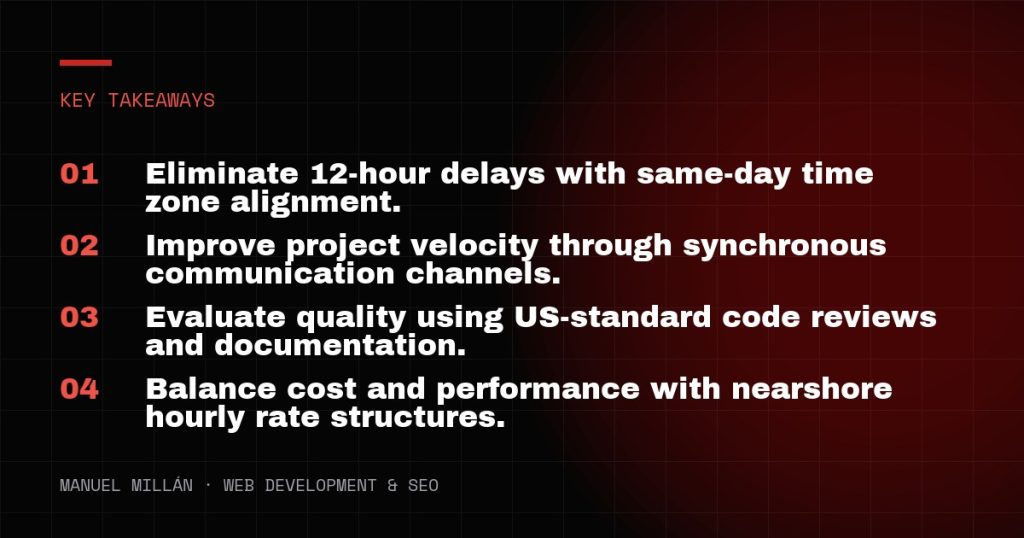
The most immediate benefit of a nearshore web development partnership is the overlap in working hours. If your agency is based in New York, Chicago, or even Los Angeles, a developer in the US Eastern or Central time zone equivalent allows for a full day of synchronous work. This eliminates the “ping-pong” effect where a question asked at 4:00 PM is not answered until the following morning, frequently resulting in a lost day of productivity.
Real-time collaboration changes the nature of web development. Instead of sending long, exhaustive emails to explain a bug, you can jump on a quick five-minute screen share. This immediacy is particularly vital during the final 48 hours before a website launch, when minor adjustments and QA checks need to happen rapidly. In 2026, where digital agility is a requirement rather than a luxury, the ability to iterate within the same business day provides a significant competitive advantage for US agencies.
Establishing Synchronous Communication Protocols
Communication is the foundation of any successful technical partnership. To make a nearshore arrangement work, you must move beyond occasional emails and adopt tools that facilitate immediate interaction. Slack, Microsoft Teams, or similar platforms should be used for daily updates, while project management tools like Jira, ClickUp, or Trello provide a single source of truth for task status.
I recommend establishing a daily “stand-up” or a brief written check-in. This ensures that everyone is aligned on the day’s priorities. Because the developer is in your time zone, these meetings can happen at a reasonable hour for both parties—no more 6:00 AM or 10:00 PM calls. Clear documentation remains essential; even though you can speak in real-time, technical specifications and edge cases should always be documented in your project management tool to prevent scope creep and misunderstandings.

Vetting for Technical Quality and Standards
A common concern with any external partner is whether the code quality meets US professional standards. When vetting a nearshore web development partnership, you should look for developers who follow modern best practices rather than just “getting it to work.” This includes writing clean, semantic HTML, using CSS preprocessors or frameworks effectively, and ensuring that WordPress or JavaScript code is modular and well-commented.
Request a code sample or a small paid trial project before committing to a long-term contract. Look for adherence to accessibility standards (WCAG), performance optimization (Core Web Vitals), and secure coding practices. A professional nearshore partner should be comfortable with version control systems like GitHub or GitLab, allowing your internal team to review code pushes and maintain a transparent development history. This transparency is the best insurance against technical debt that could surface months after a project is completed.
Bridging the Professional and Cultural Gap
Beyond technical skills, professional alignment is what makes a partnership last. Nearshore developers in Latin America often have a deep understanding of US business culture and user experience (UX) expectations. This is critical when building sites for US consumers who expect certain design patterns, payment gateway integrations, and fast loading speeds.
Cultural alignment also extends to communication styles. A partner who is comfortable asking clarifying questions rather than blindly following a flawed brief will save you thousands of dollars in rework. In my experience delivering over 50 websites, the most successful projects are those where the developer acts as a consultant, suggesting better ways to implement a feature rather than just acting as a task-taker. This level of engagement is much easier to achieve when there is a shared understanding of the target market.

Budgeting and Financial Expectations in 2026
Pricing for a nearshore web development partnership typically sits in the middle ground between low-cost offshore options and high-end US domestic rates. In 2026, you can expect to see hourly rates for experienced nearshore developers ranging from $50 to $95 USD, depending on the complexity of the stack (e.g., standard WordPress versus headless React applications).
While this is higher than what you might pay a developer in a drastically different time zone, the total cost of ownership is often lower. You save money by reducing the time your US project managers spend on coordination, decreasing the number of revision cycles, and avoiding the opportunity cost of delayed launches. When budgeting, consider the value of your own time. If a nearshore partner allows you to focus on sales and strategy instead of troubleshooting code at midnight, the investment pays for itself quickly.
Setting Up Your First Nearshore Project
If you are new to working with nearshore talent, start with a concrete, well-defined task. This could be a landing page build, a performance optimization audit, or a specific feature addition to an existing WordPress site. Use this initial project to test the communication flow, the speed of response, and the quality of the final deliverable.
Define your “Definition of Done” clearly. Does it include cross-browser testing? Does it include basic SEO metadata? Once you have established trust through a few successful smaller projects, you can move toward a white-label arrangement or a dedicated retainer model. This staged approach minimizes risk while allowing you to build a reliable technical extension of your team that operates within your own business hours.
A successful nearshore web development partnership is built on more than just proximity; it requires clear standards, shared tools, and a commitment to quality. By leveraging time zone alignment and real-time communication, US agencies can scale their operations efficiently without sacrificing the speed or quality their clients expect.
Need a reliable web partner?
I design and build fast, SEO-ready websites for businesses and agencies, including white-label projects. Tell me about yours.
Let's talk