Small Business Website Cost: 2026 Pricing and Value Guide
Understand the real small business website cost in 2026. This guide breaks down pricing tiers, hidden fees, and how to avoid expensive development mistakes.

Understanding the 2026 Pricing Tiers
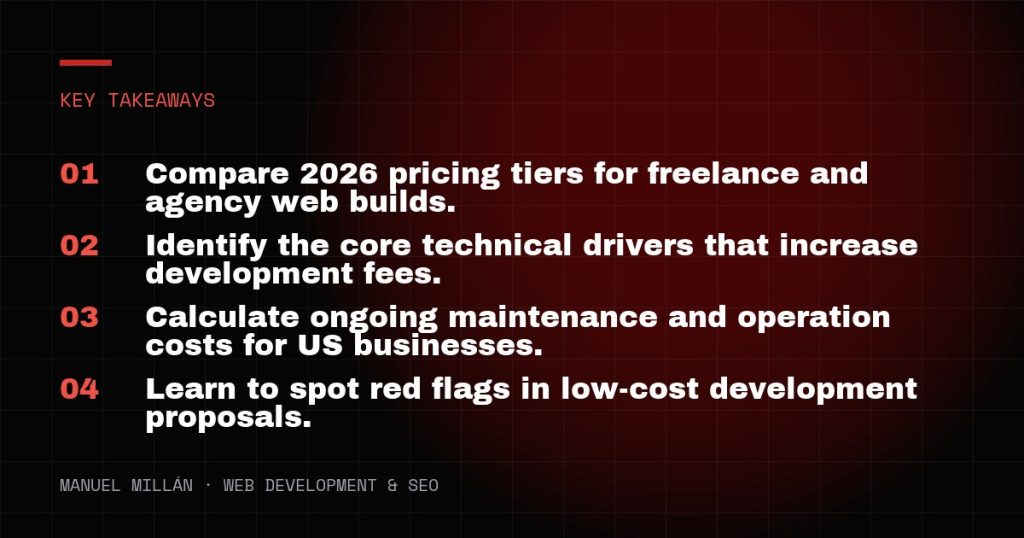
When you start researching the small business website cost for your company, you will find a massive range of quotes. In 2026, the US market is generally divided into three distinct tiers. Understanding where your business fits into these tiers prevents you from overpaying for features you do not need or under-investing in a tool that is critical to your revenue. The cost is rarely just about how many pages you have; it is about the complexity of the backend and the level of strategy involved in the build.
The first tier is the DIY or automated site builder route. Using platforms like Squarespace or Shopify, a small business might spend between $500 and $2,000 for a basic setup. This usually involves someone on your team or a junior freelancer filling in a pre-made template. While the initial cash outlay is low, these sites often lack the custom SEO structure and conversion-focused design needed to compete in a saturated US market. You are paying for a tool, not a solution.
The second tier is the professional freelance or boutique developer range. For most established small businesses in the US, this is the sweet spot. Prices typically range from $4,000 to $12,000. At this level, you are paying for custom WordPress development, unique UI/UX design, and a site that is optimized for performance. You are not just getting a website; you are getting a partner who understands lead generation and technical SEO. This tier ensures that your site is accessible, fast, and secure from day one.
The third tier involves specialized agencies. For projects starting at $15,000 and reaching well over $50,000, these agencies provide deep market research, custom integrations, and high-end brand positioning. This is usually necessary only for mid-sized businesses or those with complex e-commerce requirements that need a bespoke technical architecture to handle high traffic volumes and complex data flows.
Core Drivers of Your Small Business Website Cost
Several technical and strategic factors dictate where your final invoice lands. The most significant driver is functionality. A standard 10-page informational site for a local service business is far simpler than a site requiring a client portal, HIPAA-compliant forms, or a complex scheduling system. Every time a site needs to “talk” to another piece of software—like your CRM, an inventory management system, or a proprietary API—the development time and cost increase.
Design is another major factor. There is a difference between using a theme and building a custom UI/UX. A theme-based site is faster to launch but limits your ability to optimize the user journey. A custom-designed site allows us to build layouts specifically for your target audience’s behavior. This process involves wireframing, prototyping, and testing, which adds to the small business website cost but significantly improves conversion rates. In 2026, users have zero patience for poor mobile navigation or slow-loading visual elements.
Content and SEO preparation are often overlooked as cost drivers. If you provide all the copy and high-resolution images, the developer can focus strictly on the build. However, if you need professional copywriting, keyword research, and on-page SEO optimization as part of the launch, expect the price to rise. A site that is built without an SEO foundation is essentially invisible, meaning you will end up paying more later to fix what should have been done during the initial development phase.

The Financial Impact of “Cheap” Development
It is tempting to choose the lowest bid, especially when two proposals look similar on the surface. However, a low-cost website often carries high long-term debt. Cheap development usually relies on bloated page builders or an excessive number of plugins to achieve basic features. This leads to slow load times, which directly impacts your search engine rankings and your Google Ads Quality Score. If your site takes more than three seconds to load, you are likely losing 40% of your potential traffic before they even see your homepage.
Technical debt is a real expense. I have seen many clients come to me after spending $2,000 on a site that they cannot update, that breaks every time a plugin is updated, or that was never properly secured. Fixing these issues often costs more than building the site correctly the first time. When evaluating the small business website cost, consider the price of downtime and the cost of missed opportunities if your site fails to convert visitors into leads.
Accessibility compliance is another area where cheap sites fail. In the US, ensuring your website is accessible to users with disabilities is not just a best practice; it is a necessity to avoid legal risks. Professional developers include accessibility checks as part of their standard workflow. Low-cost providers often skip this, leaving your business vulnerable to ADA-related legal notices, which can cost thousands of dollars to settle.
Post-Launch Expenses You Must Budget For
A website is not a one-time purchase; it is a piece of infrastructure that requires maintenance. To keep your site running smoothly in 2026, you should budget for ongoing operational costs. Hosting is the first line item. While you can find hosting for $10 a month, professional-grade managed hosting for a WordPress site typically costs between $30 and $100 per month. This ensures better security, automated backups, and faster server response times.
Security and maintenance plans are also essential. These plans usually cost between $100 and $300 per month and cover core updates, plugin management, security monitoring, and small content tweaks. Neglecting these updates is the primary way websites get hacked. If you do not have an internal IT team, paying for a professional maintenance plan is the most cost-effective way to protect your investment.
Finally, consider your marketing and growth budget. A website is a tool, but it needs traffic to be effective. Whether you invest in ongoing SEO services, content production, or PPC advertising, these costs should be factored into your overall digital strategy. A $10,000 website with $0 marketing budget will perform worse than a $5,000 website with a $500 monthly marketing spend.

How to Compare Website Proposals Effectively
When you receive quotes, look past the final number. A professional proposal should clearly outline the scope of work. Does it include a discovery phase? Is mobile responsiveness a priority or an afterthought? Is the site built on a platform that you will own and be able to move later, or are you being locked into a proprietary system? These are the questions that define the value of the small business website cost you are being quoted.
Ask about the post-launch support. A developer who delivers a site and disappears is a liability. You want a partner who provides training on how to use the CMS and offers a clear path for future updates. Also, verify if the quote includes basic SEO tasks like setting up 301 redirects, optimizing meta tags, and configuring Google Search Console. If these are missing, the quote is incomplete.
To accurately compare two quotes, look at the hours allocated to design versus development. A quote that is heavy on design but light on development might result in a beautiful site that functions poorly. Conversely, a technical-heavy quote might lack the user experience polish needed to engage your customers. Balance is key. A reputable developer will be able to explain exactly why their price is set at a certain level and what the expected ROI will be for your business.
Determining the right budget for your website requires a clear understanding of your business goals and the technical requirements needed to reach them. By focusing on value and long-term performance rather than just the initial price tag, you can build a digital asset that actually contributes to your bottom line. Always prioritize security, speed, and user experience when evaluating your options.
Need a reliable web partner?
I design and build fast, SEO-ready websites for businesses and agencies, including white-label projects. Tell me about yours.
Let's talk