How to Write a Website Project Brief to Avoid Scope Creep
Learn how to write a website project brief that prevents scope creep, keeps budgets on track, and ensures your developer delivers exactly what you need.

Most website projects fail to meet their deadlines not because of technical incompetence, but because of poor communication during the initial handoff. When a website project brief lacks detail, the “I thought you meant this” conversations start, leading to delays and unexpected invoices that can quickly spiral out of control.
Scope creep is the gradual expansion of a project’s requirements beyond its original goals. In 2026, with the complexity of integrations and the high expectations for user experience, a vague brief is a recipe for a $10,000 project turning into a $20,000 headache. To prevent this, you need a document that serves as a single source of truth for both the business owner and the developer.
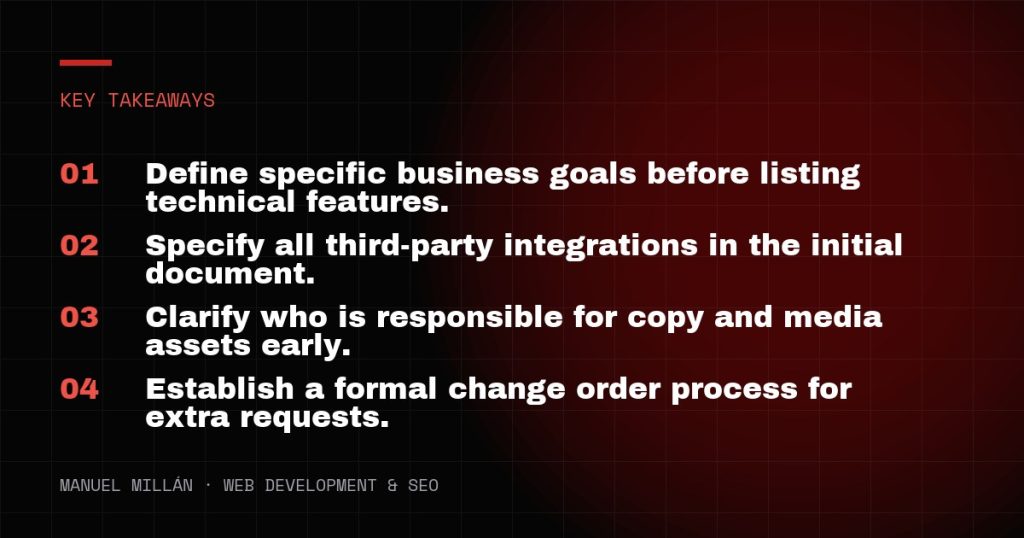
Defining Business Objectives Over Feature Lists
The first mistake many business owners make when creating a website project brief is providing a list of features without any business context. A feature is a “contact form”; an objective is “capturing lead data and syncing it directly with our Salesforce CRM to reduce manual entry for the sales team.”
When you define the “why” behind a feature, you allow your developer to suggest the most efficient technical solution. If you simply ask for a “membership area,” the developer might quote for a complex custom-coded portal. If your actual goal is just to hide three PDF guides behind a password, a much simpler (and cheaper) solution exists. Your brief should clearly state:
- The primary goal of the website (e.g., lead generation, e-commerce sales, brand authority).
- The target audience and the specific actions you want them to take.
- The current pain points of your existing site that must be solved.
- Key performance indicators (KPIs) like page load speed or conversion rate targets.
Documenting the Technical Infrastructure
Assumptions are the primary driver of scope creep. Do not assume your developer knows you need to integrate with a specific niche ERP or that you require a specific hosting environment for compliance reasons. Your brief must outline the technical ecosystem the website will live in.
CMS and Platform Preferences
If your team is already trained on WordPress, specify that. If you have no preference, ask the developer to justify their recommendation based on your long-term maintenance capacity. For most small to mid-sized US businesses in 2026, WordPress remains the standard for its balance of flexibility and SEO capabilities, but the brief should confirm this early.
Third-Party Integrations
List every tool the website needs to “talk” to. This includes:
- Email marketing platforms (Mailchimp, Constant Contact, Klaviyo).
- CRMs (HubSpot, Salesforce, Pipedrive).
- Payment gateways (Stripe, PayPal, Authorize.net).
- Analytics and tracking (Google Analytics 4, Meta Pixel, heatmaps).
- Appointment scheduling software (Calendly, Acuity).
Each integration adds complexity. If you add a request for a custom API sync halfway through the build, expect a significant change order fee.

The Sitemap and User Flow Requirements
A website project brief must include a tentative sitemap. You do not need to be a designer to do this; a simple bulleted list of pages is sufficient. This helps the developer understand the scale of the site and the depth of the navigation.
Beyond the list of pages, describe the user flow for critical actions. For example, if a user lands on a blog post, where should they go next? If they fill out a quote request, do they need to be redirected to a custom “Thank You” page with a downloadable asset? Mapping these paths early prevents the “Oh, we also need a custom dashboard for logged-in users” surprise three weeks before launch.
In 2026, mobile-first design is a given, but if your specific industry relies heavily on desktop users (such as B2B SaaS or legal services), specify that the desktop experience requires a different level of data visualization or complex filtering that might not be as critical on mobile.
Clarifying Content and Asset Ownership
Content is the number one reason website projects are delayed. Developers often build “shells” based on lorem ipsum text, only to find that when the actual copy arrives, it doesn’t fit the design. Your brief should explicitly state who is providing the following:
- Copywriting: Is the client providing final, SEO-optimized copy, or is the developer/agency handling it?
- Photography: Will there be a professional photoshoot, or is the developer responsible for sourcing high-quality stock imagery?
- Branding: Do you have a brand style guide with hex codes, fonts, and high-resolution logo files (SVG/EPS), or does the developer need to create these?
- Video: Are there large video files that need hosting on a platform like Vimeo or YouTube to maintain site speed?
If you expect the developer to migrate 100 blog posts from an old site, that must be in the brief. If they assume you are doing it and you assume they are, someone is going to be hit with an unexpected bill for manual data entry.

Establishing a Formal Change Order Process
Even the best website project brief cannot account for every single detail that might arise during a 3-month build. Stakeholders might change their minds, or a new business requirement might emerge. The key to avoiding friction is establishing a Change Order process before the project begins.
A professional developer will usually include a clause in their contract stating that any work falling outside the initial brief will be billed at an hourly rate (typically ranging from $100 to $200 per hour for US-based experts) or quoted as a separate mini-project. Your brief should acknowledge this. By agreeing on how to handle new ideas, you keep the original project on track while still allowing for flexibility.
Ask your developer how they handle “small” requests. Some may offer a bucket of 5-10 hours for minor adjustments, while others require a formal sign-off for any change that takes more than 30 minutes. Clear boundaries here protect your budget and the developer’s time.
A Practical Path Forward
A thorough brief is not about micromanaging the developer; it is about providing the boundaries within which they can do their best work. When both parties understand the technical requirements, the content responsibilities, and the ultimate business goals, the project moves faster and produces a better ROI. Start with your goals, list your technical must-haves, and be honest about who is providing the content. This clarity is what separates successful launches from expensive failures.
Need a reliable web partner?
I design and build fast, SEO-ready websites for businesses and agencies, including white-label projects. Tell me about yours.
Let's talk